Laser-Based Measurement & Trials
Conduct non-contact measurement trials using compatible laser-based sensing devices. Capture vibration, movement, and structural response data to help assess the condition of specific assets and components.
Software
Detect the changes you can't see.
From bridges and buildings to industrial machinery and transport infrastructure, VIDUR Raksha helps teams assess asset condition through sensor-based trials, track changes over time, and identify potential problems before they develop into major failures.
Overview
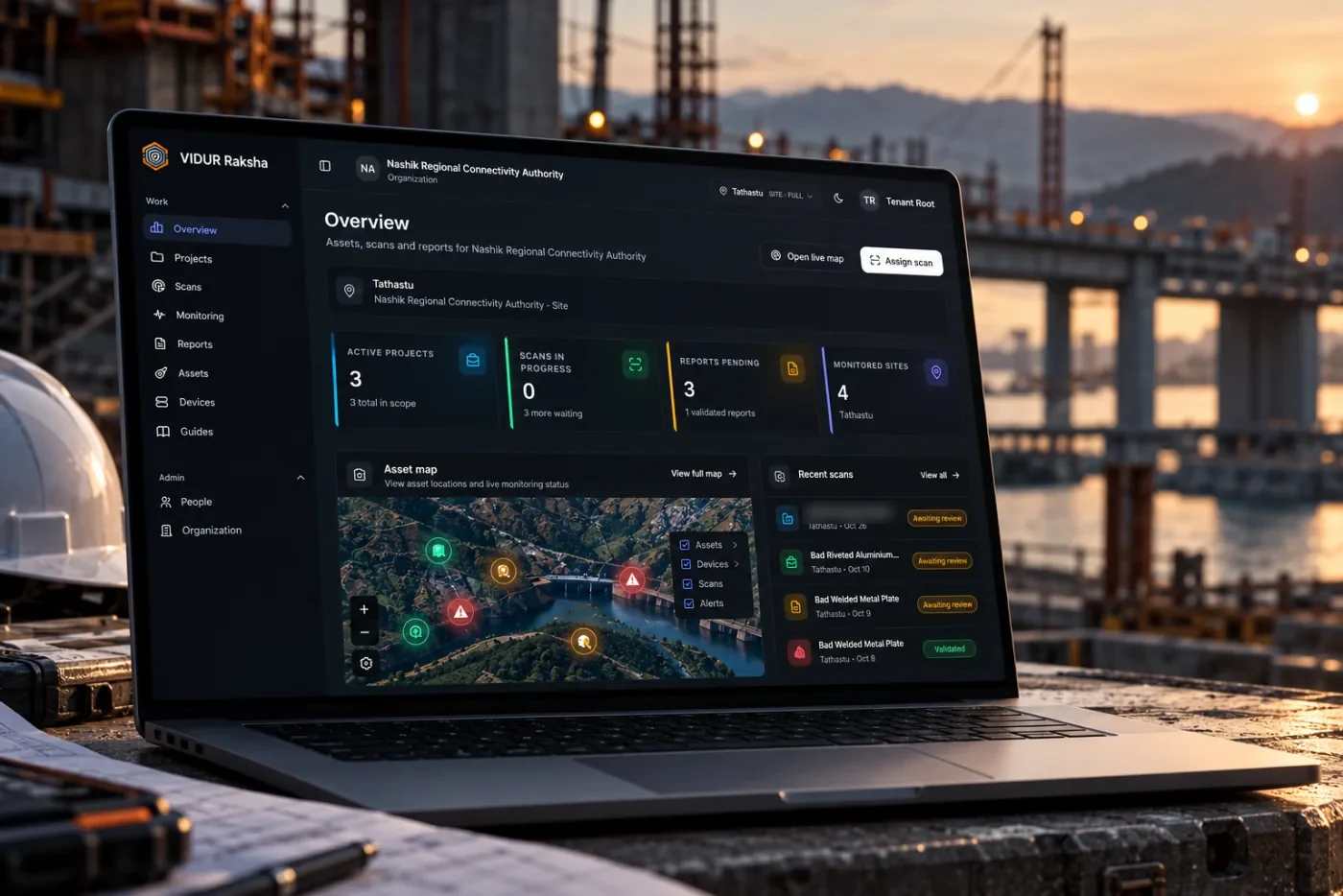
VIDUR Raksha is an enterprise asset health intelligence platform for structural health monitoring, condition monitoring, quality assurance, and predictive maintenance.
Working with laser-based sensing devices and compatible monitoring systems, the platform helps teams conduct measurement trials, analyse asset behaviour, and maintain structured condition records for individual components and entire assets.
Each trial adds information to an asset's history. By comparing measurements taken at different points and across repeated inspections, teams can understand how an asset is performing, identify unusual changes, and assess whether its condition is stable or deteriorating.
From a single structural component to an entire infrastructure network, VIDUR Raksha brings inspection results, historical trends, asset locations, and reports into one organised system.
Core capabilities
Conduct non-contact measurement trials using compatible laser-based sensing devices. Capture vibration, movement, and structural response data to help assess the condition of specific assets and components.
Organise assets into sites, divisions, individual assets, and components. Maintain structured records that connect inspection results to the exact locations and components being assessed.
View geo-tagged assets on an interactive map, identify their locations, and help field teams navigate to assigned inspection sites.
Create inspection projects, select assets and components, schedule trials, and assign responsibilities to field personnel. Keep planned, ongoing, and completed measurement activities organised.
Compare results from repeated trials to understand changes in an asset's behaviour over time. Identify trends, unusual deviations, and signs that may require closer inspection.
Use measurement history and asset information to help identify components that require attention, supporting more informed inspection and maintenance planning.
Generate structured reports linked to assets, components, and measurement trials. Maintain inspection histories and reviewed reports for engineering, maintenance, and compliance teams.
Use CATS's Vidur system for non-contact, real-time measurement of vibration, displacement, velocity, and acceleration.
How it works
Register structures, equipment, and their individual components within the platform, including their locations and relevant details.
Select the assets or measurement points to be inspected, schedule trials, and assign them to field personnel.
Field teams locate assigned assets and conduct trials using the connected sensing equipment.
Measurement data is processed and associated with the relevant asset or component, helping teams assess its current condition.
Repeat inspections at planned intervals to compare results, identify deterioration trends, and support maintenance decisions.
Applications
Assess structural components such as columns, girders, supports, and other critical elements. Repeated inspections help teams understand how structures behave and change over time.
Support condition assessment of railway structures, tracks, viaducts, and other transport assets where vibration, movement, and structural stability matter.
Support inspection and condition assessment of suitable aircraft components, airport infrastructure, and other engineered structures where precise measurement is important.
Assess vibration and mechanical behaviour in industrial equipment, structural frames, production machinery, and material-handling systems.
Monitor the condition of selected components across power facilities, pipelines, industrial installations, and other critical assets.
Manage inspection programmes across multiple sites, structures, and components while maintaining a consolidated history of measurement results and asset condition.
Built for the Teams Responsible for Asset Health
Maintain visibility into asset condition, inspection histories, and areas requiring attention across infrastructure portfolios.
Access assigned trials, locate assets, capture measurements, and organise inspection results through a structured workflow.
Use condition trends and inspection findings to help prioritise maintenance activities and investigate emerging problems.
Review measurement results, maintain documented inspection histories, and support condition assessments and quality verification.
Benefits
Use sensor-based measurements to identify unusual vibration, movement, or structural behaviour that may not be immediately visible.
Build a condition history through repeated trials, helping teams distinguish stable performance from gradual deterioration.
Use asset condition information and risk priorities to direct attention toward components that may require closer investigation.
Organise trials, reports, measurement history, and component information in one place instead of managing disconnected records.
Connect asset locations, trial assignments, and inspection workflows so field teams know where to go and what needs to be measured.
Use historical trends and condition assessments to support preventive maintenance decisions rather than relying only on visible damage or unexpected failures.
Contact CATS
Send us a question, a requirement or a demo request.